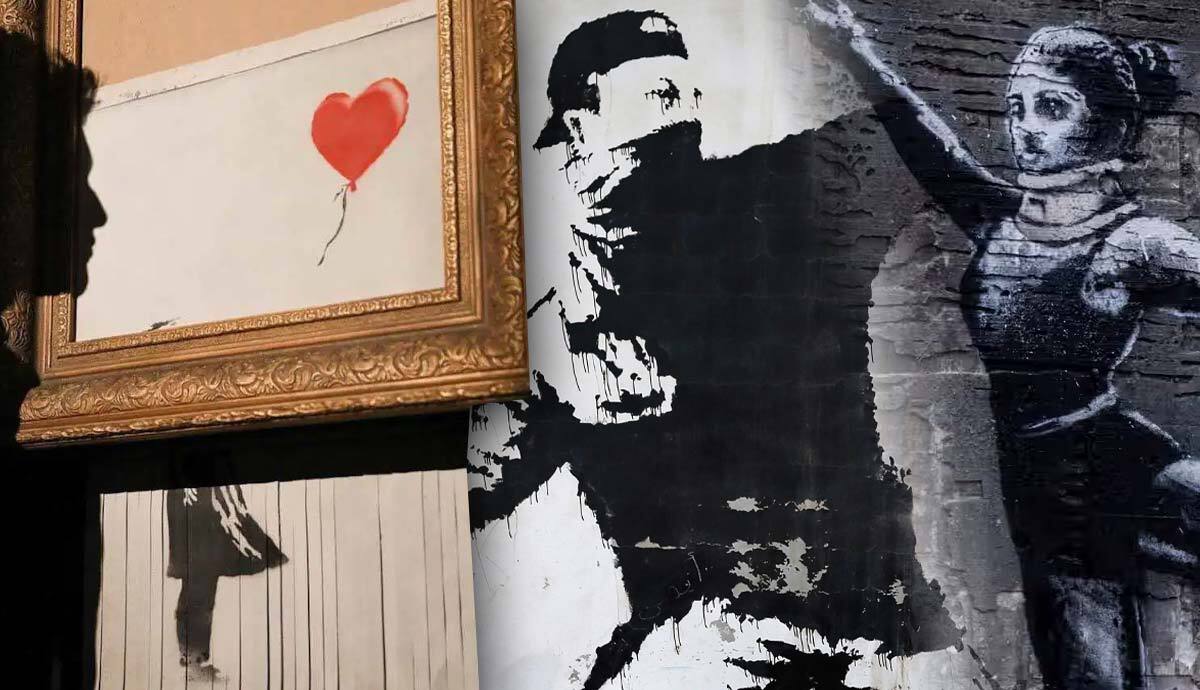
Banksy's Identity Clues: What He Said About Hiding His Face
For decades, the world has been captivated not only by the provocative, thought-provoking art of Banksy but also by the impenetrable veil shrouding his identity. The quest for a definitive Banksy face reveal has fueled endless speculation, academic debate, and journalistic investigations. While the elusive street artist has masterfully maintained his anonymity, occasional glimpses, interviews, and even near-misses offer tantalizing clues into his motivations and the persona he presents to the world. One such pivotal moment came with the unearthing of a rare 2003 ITV interview, where a man claiming to be Banksy explicitly articulated his reasons for remaining hidden, shedding a unique light on the man behind the stencils.
The Elusive Artist: Why Anonymity is Key to Banksy's Art
Banksy's art thrives on its defiance of convention, its critical commentary on society, and its illegal placement in public spaces. His anonymity is not merely a preference; it's a fundamental principle woven into the fabric of his artistic practice and public persona. When questioned directly about hiding his face in the 2003 interview, the man believed to be Banksy stated, "I’m disguised because you can’t really be a graffiti writer and then go public. The two things don’t quite go together." This succinct explanation encapsulates the core dilemma faced by any street artist operating outside legal boundaries.
From a practical standpoint, anonymity offers protection from legal repercussions associated with vandalism and trespassing, which are inherent to much of street art. Without a public identity, Banksy can continue to operate with a freedom that would be impossible for a known figure. More profoundly, however, his hidden identity shifts the focus away from the artist as an individual celebrity and squarely onto the art itself and its message. His powerful statements on consumerism, war, poverty, and political hypocrisy resonate universally, unburdened by the distractions of personal fame, wealth, or a public persona.
This deliberate obscurity also allows Banksy to maintain a sense of mystery and intrigue, keeping the public engaged not just with his new works but also with the ongoing riddle of his identity. It's a masterful strategy that has elevated him from a mere graffiti artist to a global phenomenon, where the absence of a Banksy face reveal is as much a part of his brand as the art itself. It ensures that every new piece is met with speculation and excitement, reinforcing the idea that the art is bigger than any single person.
The 2003 ITV Interview: A Glimpse Behind the Veil?
In July 2019, a forgotten piece of television history resurfaced: a rare ITV London news interview filmed in 2003, predating Banksy’s breakthrough "Turf War" exhibition. The footage features a man, face partially obscured by a baseball cap and T-shirt, actively stencilling a black insect onto a wall. Correspondent Haig Gordon chats with the man for approximately 35 seconds, providing what many consider to be one of the most direct encounters with the enigmatic artist to date.
During the exchange, the interviewee clearly articulates his rationale for disguise: "I’m disguised because you can’t really be a graffiti writer and then go public. The two things don’t quite go together." This statement remains the most explicit utterance from someone claiming to be Banksy regarding his anonymity. Further into the conversation, Gordon questions the artist about an act of guerilla art—spraying "Designated Riot Area" on Nelson’s Column. The man's casual reply, "I thought that was quite funny," showcases a characteristic wit often associated with Banksy's artistic commentary.
Perhaps the most telling interaction comes when Gordon playfully asks, "You don’t mind if I pass your details on to the police?" To which the man confidently retorts, "No. What details have you got?" This blend of nonchalance and sharp intellect paints a picture of an artist fully aware of the implications of his work, yet seemingly unafraid.
Haig Gordon, since retired, recalled the man’s demeanor as "relaxed, laid-back, amiable," confessing he "quite took to him" and found him "very pleasant," dreading a "pretentious arty-farty type." While Gordon couldn't definitively confirm the man's identity, he noted it "seemed like an organised event," suggesting a level of controlled access. Banksy’s team, when approached about the footage, offered their standard, enigmatic response: "No comment. We get loads of these." For a deeper dive into this pivotal moment, check out our related article: Unearthed ITV Interview: Did We Just See Banksy's Face?
Decoding the Clues: What Can We Learn from the Interview?
While the 2003 ITV interview doesn't offer a definitive Banksy face reveal, it provides invaluable insights into the artist's psyche and the strategic construction of his anonymity. The man's statements are direct and pragmatic, rooted in the inherent conflict between illegal street art and public recognition. This reinforces the idea that Banksy's anonymity isn't about shyness but about maintaining the integrity and efficacy of his artistic practice.
His wit and confidence, particularly in the exchange about the police, suggest a personality that is both clever and self-assured, consistent with the audacious nature of his public interventions. Haig Gordon's impressions of the man being "amiable" and "not pretentious" align with a popular perception of Banksy as an artist of the people, rather than an elitist figure. This humanized description, despite the partial disguise, offers a rare glimpse into the person behind the legend.
The "organised event" aspect, as observed by Gordon, is particularly intriguing. It hints that this "accidental" encounter might have been a carefully managed interaction, designed to offer just enough information to fuel the myth without compromising the artist's identity. Banksy has consistently demonstrated an acute understanding of media and public relations, using "no comments" and carefully orchestrated events to perpetuate his mystique. This interview, therefore, might be seen as an early example of his masterful manipulation of public perception, where the ambiguity itself becomes part of the art. To further dissect the nuances of this rare footage, read our analysis in Banksy's Anonymity: Decrypting the Rare 2003 TV Interview.
The Enduring Myth of Banksy: Beyond a Face Reveal
The pursuit of a Banksy face reveal persists, yet the artist’s continued success arguably hinges on the very absence of one. His anonymity grants him several distinct advantages:
- Legal Shield: It protects him from the criminal charges associated with his illicit street art.
- Artistic Freedom: Without a public identity, his work is immune to the personal criticisms or biases that might be directed at a known individual.
- Universal Appeal: His messages, often politically charged, can speak to a wider audience without the baggage of his personal biography. The focus remains on the message, not the messenger.
- Market Value: Ironically, his anonymity also fuels the high demand and speculative value of his authenticated works, managed by his company Pest Control Office, which also operates anonymously.
Perhaps the true genius of Banksy isn't just in his stencils but in his masterful manipulation of media and public perception, making the quest for a Banksy face reveal an integral part of his ongoing performance. Any "reveal" would need to be considered carefully, as it could fundamentally alter the dynamic of his art and public interaction.
Fact: While his identity remains secret, Banksy maintains a strict authentication process for his works through a company called Pest Control Office, which also operates with a degree of anonymity.
Tip: When evaluating any potential Banksy "reveals" or theories, always consider the source and Banksy's historical penchant for misdirection and playing with public expectations.
Actionable Advice: Instead of fixating on who Banksy is, perhaps the more enriching approach is to focus on what Banksy says through his art. His identity, ultimately, might be less important than the powerful dialogues his work provokes.
The unearthed 2003 ITV interview serves as a fascinating footnote in the ongoing saga of Banksy's identity. It offered a fleeting, ambiguous glance at a figure who concisely explained his fundamental reason for remaining hidden: the incompatibility of being a graffiti writer and a public persona. While it didn't provide a definitive Banksy face reveal, it solidified the strategic nature of his anonymity, affirming that for Banksy, the mystery is not merely a tactic but an essential component of his art. As long as his identity remains unknown, the legend of Banksy continues to grow, ensuring his messages resonate far beyond the confines of a canvas or a city wall, proving that sometimes, what remains hidden is far more powerful than what is revealed.